2025年11月24日星期一

Why Is The Haomei Self Loading Concrete Mixer Truck Favored Worldwide

 On rural road construction sites in Southeast Asia, infrastructure projects in Africa, and small-scale municipal engineering projects in Europe, construction machinery bearing the "Made in China" label is increasingly becoming a mainstay.

Among them, the self loading concrete mixer, as innovative equipment changing traditional construction methods, is creating a transformative wave in the global market thanks to the technological breakthroughs and cost advantages of Chinese brands.
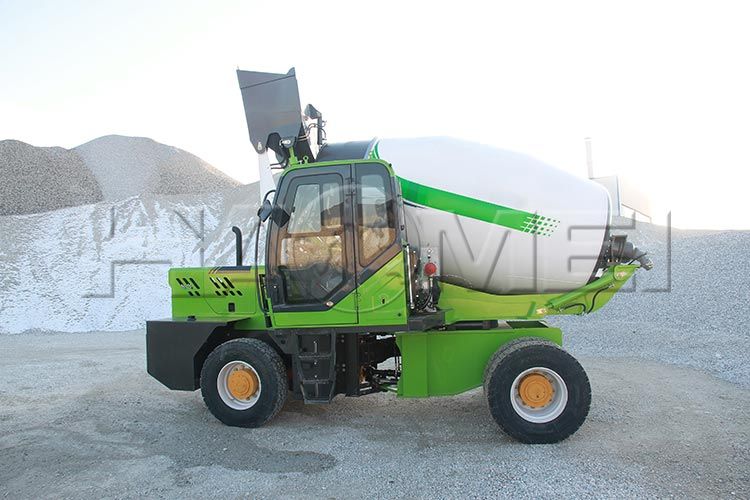
self loading concrete mixer truck.jpg

Traditional concrete construction has long relied on a combination of multiple equipment—"mixing plant + loader + transport vehicle"—which is not only cumbersome and labor-intensive but also ineffective in remote areas or complex terrains.

Chinese brands have keenly grasped this industry pain point, reconstructing equipment logic with an integrated approach, and Haomei Machinery has taken this innovative concept to its extreme. Compared to ordinary concrete mixer trucks, Haomei Machinery's self-loading mixer truck's core breakthrough lies in achieving full-process integration of "loading, weighing, mixing, transportation, and unloading," completely overturning the traditional construction model.

In terms of functional integration, Haomei Machinry has solved multiple problems with a single system. The specialized bucket at the front of the equipment acts like a "smart arm," precisely scooping raw materials such as sand, gravel, and cement directly from the stockpile. Its built-in high-precision electronic weighing system controls the material ratio in real time, avoiding errors from manual operation.

During transportation, the mixing drum rotates continuously at a constant speed, producing uniform and fresh concrete upon arrival at the construction site, eliminating the need for a stationary mixing plant.

Facing complex road conditions such as mountain paths and steep slopes, its reinforced chassis and powerful power system ensure stable passage, while the rotating unloading chute precisely delivers concrete to the pouring point. The entire process can be completed by a single operator.

This "one person, one machine, one process" model has increased the efficiency of rural road hardening projects in Southeast Asia by 40% and alleviated equipment shortages for small-scale water conservancy projects in remote areas of Africa.

Cost control is a key factor for Chinese brands to penetrate the international market, and Haomei self loading concrete mixer truck demonstrates strong competitiveness in this area. For small and medium-sized construction companies overseas, equipment procurement and labor costs are often the biggest burdens.

Haomei's self-loading concrete mixer truck can replace three traditional pieces of equipment—loader, concrete mixer, and transport truck—directly reducing manpower input by over 60%. Simultaneously, the on-site mixing mode avoids waste during initial setting of concrete during transportation, increasing material utilization to over 95%.

Furthermore, the cost-effectiveness advantage brought by the Chinese supply chain allows Haomei equipment to shorten its return on investment cycle by nearly half compared to similar international products. In a municipal maintenance project in Europe, the construction team reduced single-project costs by 30% after adopting Haomei equipment, a figure that has prompted many European and American clients to proactively seek cooperation.

If integration and cost-effectiveness are the "stepping stones," then reliable quality is the "ballast" for Chinese brands to establish themselves in the international market. Haomei Machinery deeply understands the characteristics of construction machinery—"harsh working conditions and continuous operation"—and adheres to high standards for core components.

Haomei's self-loading concrete mixer truck is equipped with internationally renowned brand engines and hydraulic systems, ensuring stable operation in extreme environments such as high temperatures and dust storms; the mixing drum uses high-strength wear-resistant steel, extending its service life by 20% compared to the industry average; and a precise intelligent control system can monitor equipment operating status in real time, reducing the failure rate.

This "hard power" has earned Haomei a good reputation in overseas markets. In oilfield infrastructure projects in the Middle East desert region, Haomei self loading mixer trucks operated at high intensity for three consecutive months without any problems, and were called "reliable partners in the desert" by the local construction team.

Original Source: https://www.self-loading-mixer.com/a/why-is-the-haomei-self-loading-concrete-mixer-truck-favored-worldwide.html

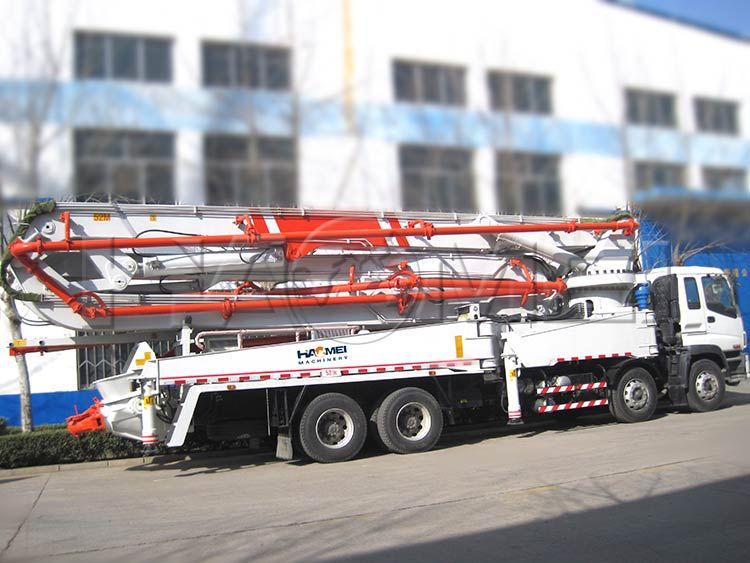
What Is Automatic Pump Truck

In the construction industry, concrete pouring efficiency directly impacts project progress. The automatic pump truck, as core equipment, has become the preferred choice for large-scale projects due to their dual advantages of "automation" and "high-efficiency delivery."

cement pump truck cost .jpg

Core Structure

1. Boom operating system

The boom is the "signature component" of an automatic concrete boom pump and a key difference from ordinary concrete pumps. A qualified boom system must meet two requirements:

Multi-section boom + flexible joints: It is typically equipped with 3-6 folding boom sections, primarily made of high-strength steel, enabling 360° rotation and multi-angle extension/retraction. The maximum working radius can reach 30-60 meters, covering complex pouring scenarios such as high-rise buildings and large factories.

Automatic positioning function: Through laser positioning or GPS navigation, the boom end can automatically align with the pouring point, avoiding errors from manual adjustments. This is especially suitable for continuous pouring operations on large-area floor slabs and walls, with positioning accuracy controllable within ±5cm.

2. Concrete Conveying System

The conveying system determines the efficiency and quality of concrete delivery. Core components include:

Dual-cylinder plunger pump: This is the "power core" of the automatic concrete boom pump. Through the alternating movement of two plungers, concrete is drawn from the hopper and pressurized for delivery. The conveying capacity can reach 80-150 m³/h, and it can stably deliver concrete with a slump of 50-230 mm, meeting various engineering needs.

Pipelines and lubrication system: The conveying pipeline must extend synchronously with the boom. The inner wall is made of wear-resistant material to extend its service life. It is also equipped with an automatic lubrication system that regularly lubricates the plungers, seals, and other components to reduce wear and prevent leakage.

3. Automated Control System

The core of "automation" lies in the control system. A qualified automatic concrete boom pump should possess the following features:

One-button operation: Pouring parameters (such as delivery volume and boom angle) can be set via a touchscreen. The system can automatically complete the boom deployment, concrete delivery, and boom retraction processes without repeated manual adjustments, reducing operational difficulty.

Safety protection and fault warning: The system monitors equipment status in real time (such as oil pressure, oil temperature, and boom position). If abnormalities such as overpressure, excessive oil temperature, or boom deviation occur, it will immediately stop the machine and issue an alarm, while displaying the cause of the fault for easy maintenance. Furthermore, it has anti-tipping and anti-collision functions to ensure construction safety.

Features

1. High efficiency

Through automated operation, the automatic concrete boom pump can achieve "one-person operation, fully automatic" delivery, increasing delivery efficiency by more than 30% compared to ordinary pump trucks.

2. High precision

The automated control system's precise boom positioning ensures stable delivery, effectively avoiding errors from manual operation. Meanwhile, the system can adjust the delivery rate in real time to avoid formwork cracking due to excessively fast material supply or cold joints due to excessively slow material supply.

3. High Adaptability

The boom of the automatic concrete boom pump can flexibly adjust its angle and length to adapt to different construction scenarios: in narrow construction sites, the folding boom can reduce the footprint; in high-altitude operations, the boom can extend to a working surface tens of meters high, eliminating the need for scaffolding; in addition, some equipment also has an off-road chassis, allowing it to travel on muddy and rugged terrain, meeting the needs of field projects (such as highways and water conservancy projects).

4. Easy Maintenance

The automated control system not only provides early warning of faults but also records equipment operating data (such as working hours, delivery rate, and maintenance cycle), facilitating users in developing maintenance plans. Furthermore, core components (such as the plunger pump and boom joints) adopt a modular design, allowing for quick component replacement during maintenance and reducing downtime. The whole cement pump truck cost is not high.

Original source: https://www.concrete-pump-cn.com/a/what-is-automatic-pump-truck.html

Planetary Pan Mixer for Concrete Precast Plant

 The quality of precast concrete components directly determines the safety and durability of building structures. As the core equipment in the concrete precast plant, the choice of the mixer is considered the "first hurdle to quality."

Unlike ordinary concrete, precast components often require higher strength uniformity, and some involve special concrete mixes such as fiber-reinforced and self-compacting concrete. Certain dry-hard and semi-dry-hard concretes also pose stringent challenges to mixing precision.

concrete precast plant.jpg

Furthermore, in factory-scale mass production, mixing efficiency, equipment stability, and maintenance costs directly impact operational efficiency. While there are many types of mixers on the market, few can simultaneously meet all these requirements.

The biggest highlight of planetary mixers lies in their dual mixing mode of "revolution + rotation": the mixing blades revolve around the central axis while simultaneously rotating at high speed around their own axis, forming a three-dimensional mixing trajectory.

This motion method completely revolutionizes the mixing logic of traditional mixers. The blades can fully penetrate the material, thoroughly mixing and kneading both basic aggregates like cement and sand, and special components such as steel fibers and mineral admixtures. This fundamentally eliminates dead zones in the mixing process, ensuring a highly uniform particle distribution in every cubic meter of concrete.

Data shows that the homogeneity error of concrete mixed by planetary mixers can be controlled within an extremely small range, which is the core guarantee for achieving the required strength and smooth appearance of precast components.

Besides its uniformity advantage, the planetary pan mixer also offers significant efficiency advantages. Due to the denser mixing trajectory and more thorough action, its mixing time is reduced by nearly 30% compared to traditional twin-shaft mixers, achieving a higher output rate in the same amount of time.

For fiber-reinforced concrete, a common problem in precast component plants, traditional mixers often suffer from fiber entanglement and clumping. The high-frequency shear mixing action of planetary mixers ensures that the fibers are evenly dispersed in the concrete, guaranteeing the crack resistance of the components while avoiding material waste.

It can easily handle high-end mix proportions such as C150 ultra-high strength concrete and RPC reactive powder concrete, and is also compatible with the mixing needs of dry-hard, semi-dry-hard, and self-compacting concrete. It can even be used for mixing special materials such as glass and ceramics. This "one machine, multiple uses" characteristic eliminates the need for precast component plants to change equipment for different types of components, greatly improving the flexibility of the production line.

From an operating cost perspective, planetary mixers also demonstrate significant advantages. Their advanced sealing system effectively reduces material leakage and equipment wear. They have fewer vulnerable parts than traditional equipment, and regular maintenance can be completed in just 30 minutes, resulting in significantly reduced maintenance costs over the long term. At the same time, the efficient mixing mode means lower energy consumption per unit of concrete. Combined with the increased efficiency of mass production, this significantly reduces the production cost per precast component.

Original source: https://www.concretebatchplanthm.com/a/planetary-pan-mixer-for-concrete-precast-plant.html

2025 Haomei Machinery at PhilConstruct Exhibition #construction #exhibit...

Every year, Haomei Machinery will attend the main international construction exhibitions world wide like Philippines, UAE, Indonesia,etc. We...