2026年3月3日星期二

Automatic Cement Brick Making Machine in Zambia

 In Zambia, the construction industry is booming with the acceleration of urbanization and the continuous advancement of infrastructure projects, creating broad growth potential for the cement brick machine market.

In the Zambian market, the concrete block making machine for sale is available in a variety of types, primarily manual, semi-automatic, and automatic. Manual brick machines are relatively inexpensive, simple in structure, and easy to operate, making them a more economical choice for small construction projects or self-employed individuals with limited funds.

Semi-automatic brick machines, based on manual machines, add some mechanized features, resulting in improved production efficiency. They are suitable for medium-sized brick factories and can meet the demand for construction bricks within a certain area.

automatic cement brick making machine.jpg

However, the automatic cement brick making machine is currently becoming increasingly popular in the Zambian market. With the significant increase in demand for bricks in the construction industry and the increasing demands for production efficiency and product quality, the advantages of automatic brick machines are becoming increasingly prominent. Many large-scale construction projects and large-scale brick factories are opting for automatic brick machines to ensure efficient and stable production.

Advantages of Automatic Brick Machines

The highly automated production process is their core competitive advantage. The entire production process requires virtually no human intervention, requiring only a small number of workers for necessary monitoring and equipment maintenance. This feature not only greatly improves production efficiency but also significantly reduces labor costs.

According to actual production data, a medium-sized automatic brick machine can produce tens of thousands of bricks per day, achieving several times or even dozens of times higher production efficiency than traditional manual brick machines.

Automatic brick machines also excel in product quality control. Leveraging advanced control systems and precise metering devices, they ensure highly accurate raw material ratios during each production run, guaranteeing consistent quality and performance for each cement brick. The resulting bricks are not only dimensionally precise and smooth in appearance, but also meet the strict standards of the construction industry in key quality indicators such as strength and density, providing a solid and reliable material guarantee for high-quality construction across various projects.

Automatic brick machines also excel in energy conservation and environmental protection. Their advanced mixing and molding technologies ensure thorough and uniform mixing of the cement mixture during production, effectively reducing raw material waste and lowering energy consumption.

Through structural optimization and the use of appropriate environmentally friendly materials, the machine's noise and exhaust emissions are effectively controlled during operation, fully complying with Zambia's increasingly stringent environmental regulations. This is crucial for brick factories to achieve sustainable development strategies.

Automatic brick machines also offer exceptional production flexibility. They can quickly and easily change molds to meet varying market demands, effortlessly producing a wide range of cement product specifications and types. From common building blocks and standard bricks to kerbstones for road construction, they can meet a wide range of needs. This demonstrates their strong market adaptability and ability to fully meet the diverse demands of the construction market.

Price Range

The price of an automatic brick machine is influenced by a variety of factors, including its production capacity, degree of automation, brand recognition, and specific configuration. In the Zambian market, small automatic brick machines typically cost tens of thousands of dollars. Welcome to inquire block making machine price in Zambia from us directly.

Original source: https://www.haomei-machinery.com/a/automatic-cement-brick-making-machine-in-zambia.html

What Makes a High-Efficiency Self Loading Concrete Mixer Truck

 Materials are the foundation of equipment durability and a crucial guarantee of concrete quality. The self loading concrete mixer truck operates in complex environments, often facing heavy loads, bumpy rides, and material abrasion. Therefore, material selection must balance the equipment's high-intensity operational requirements with the stability of concrete performance, forming a dual quality defense line to mitigate the risk of malfunctions and potential quality issues from the outset.

In terms of equipment structure, core load-bearing components such as the chassis utilize Baosteel special steel or 700L-grade ultra-high-strength steel. Their tensile strength and impact resistance far exceed those of ordinary steel, effectively handling structural stresses during heavy-duty transportation and preventing chassis deformation and breakage.

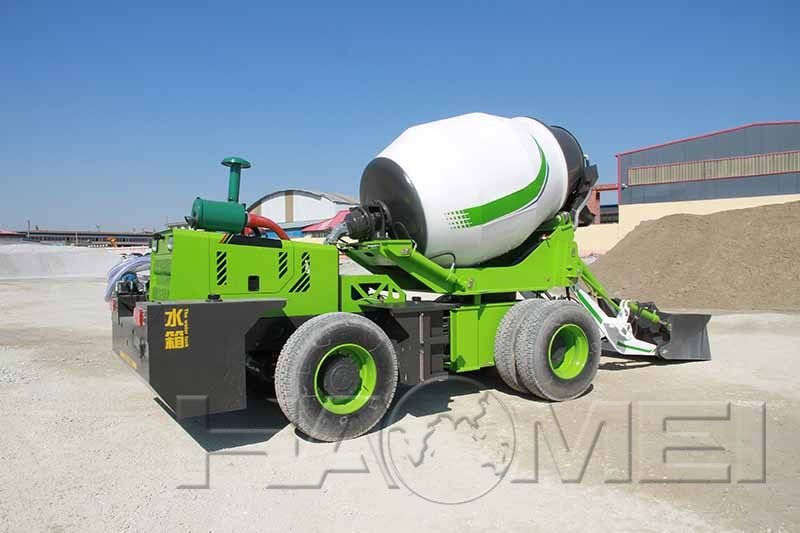
self loading concrete mixer truck.jpg

As a core working component, the mixing drum is of paramount importance in material selection. Mainstream models often utilize BW300TP next-generation wear-resistant steel or NM400 low-alloy wear-resistant steel, jointly developed with Baosteel.

These steels achieve a hardness of HB300 and wear resistance more than twice that of ordinary steel plates. Furthermore, through equal thickness design and the addition of wear-resistant strips on the blades, the tank body and blades wear synchronously, extending service life by 50% compared to ordinary products, reaching 8-10 years.

In addition, the sub-beams of the upper structure use rectangular tubular steel with superior tensile strength, and the chassis connecting parts use cast alloy steel with higher hardness. The precise matching of materials in each part to operational requirements ensures the stability and reliability of the entire vehicle structure.

It is worth noting that material selection must also consider concrete quality assurance. Wear-resistant and corrosion-resistant tank materials prevent impurities from steel wear from mixing into the concrete, thus preventing a decline in concrete strength. Materials with excellent sealing performance reduce moisture loss during transportation, ensuring stable concrete slump and laying a solid foundation for project quality.

In terms of intelligent control, the new generation of the self loader concrete mixer generally integrates multi-source sensor fusion and intelligent control algorithms to achieve full automation and precision in the operation process. The onboard digital weighing system can accurately weigh the amount of aggregate, cement, and water in real time, with error control at an industry-leading level.

Combined with a fully automatic water addition control system, it can automatically adjust the amount of water added according to different concrete mix proportions, avoiding human error and controlling the 28-day strength variation coefficient of concrete to within 3.5%, far exceeding the industry average.

Technical optimization of operational functions also continuously improves practicality. The mixing drum adopts the Archimedean spiral principle to design double logarithmic spiral blades, combined with laser dynamic balancing correction technology, ensuring that the concrete continuously undergoes axial and radial composite motion during transportation, preventing segregation and initial setting.

After two hours of continuous operation, the slump loss is controlled to within 15% of the initial value. The discharge system is equipped with a 270° rotating unloading chute and a hydraulic telescopic chute, enabling precise pouring from multiple angles, reducing secondary transfers, and adapting to different construction scenario requirements.

The combination of high-quality materials, stringent quality control, and technological iteration ultimately translates into the core competitiveness of self-loading concrete mixer trucks—comprehensive efficiency improvement. This improvement is not only reflected in the faster operation speed of individual stages, but also in the optimization of the entire process and cost savings, creating significant economic and time value for construction companies.

Original Source: https://www.self-loading-mixer.com/a/what-makes-a-high-efficiency-self-loading-concrete-mixer-truck.html

Self Loading Concrete Mixer Truck

 A self-loading concrete mixer truck combines material loading, water dosing, mixing, and discharge in one mobile machine. For contractors working in areas with limited batching access, tight schedules, or high labor costs, this equipment can help keep pours continuous without relying on external loaders or ready-mix delivery windows.

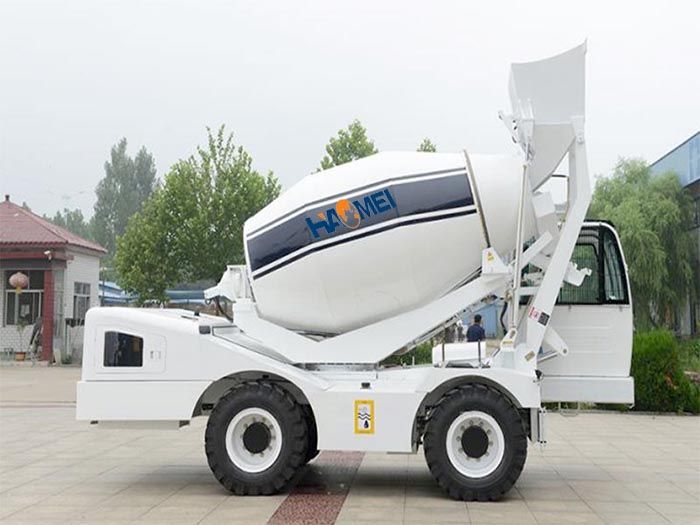
self loading concrete mixer truck

Unlike a standard transit mixer that mainly transports premixed concrete, this type is designed to produce concrete on site from cement, aggregates, and water. Most models use a front-mounted loading bucket to scoop aggregates, an onboard water tank with a metering system, and a rotating drum that mixes during travel and discharges at the point of placement. The result is a compact, jobsite-focused solution for slabs, small foundations, rural construction, utility work, and repair projects where flexibility matters.

How It Works And Where It Fits

The typical workflow is straightforward. The operator drives to the stockpile, loads aggregates with the bucket, adds cement (bagged or from a small silo setup), meters water, and mixes in the drum while moving to the pour location. Discharge is usually through a chute, with the drum reversing to control flow.

Where this machine stands out is independence. It reduces coordination with a wheel loader and minimizes downtime caused by waiting for ready-mix trucks. It is also useful when access roads, weight limits, or remote locations make regular supply difficult.

Common applications include:

  • Rural house construction and small commercial builds

  • Sidewalks, curbs, and municipal maintenance

  • Farm and industrial yard slabs

  • Tunnel, slope, and drainage works with scattered pour points

If you are also evaluating conventional transport solutions, a dedicated Concrete Mixer Truck may still be preferred for high-volume city pours supplied by a central batching plant.

Design Features That Impact Productivity

Not all configurations deliver the same output. Focus on design details that affect cycle time, mix consistency, and operator control.

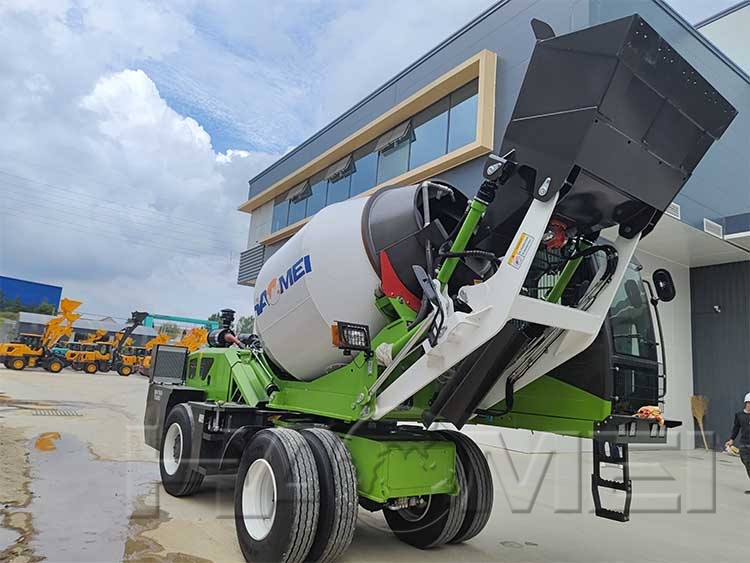
self loading concrete mixer machine

Key components to compare:

  • Loading bucket geometry and breakout force: A deeper bucket and strong hydraulics improve loading speed in coarse aggregates.

  • Water dosing system: Look for a metered system rather than manual filling, especially when mix repeatability is important.

  • Drum and blade design: Blade angle and wear-resistant liners support faster, more uniform mixing.

  • Transmission and driveline: Hydrostatic drive can improve low-speed control on uneven sites, while mechanical drive may offer simpler maintenance.

  • 4x4 and steering modes: Articulated steering, crab steering, or tight turning radius help in confined sites.

  • Operator visibility and controls: Camera options, ergonomic joysticks, and clear gauges reduce operator fatigue.

Typical Specs To Request From A Supplier

Ask for verified performance ranges rather than marketing labels. The table below lists what procurement teams usually compare first.

ParameterWhat To Ask ForWhy It Matters On Site
Batch outputm3 per batch and hourly productivityDetermines how many workers and placements you can support
Drum capacityTotal and effective mixing volumePrevents overloading and poor mix quality
Water tankCapacity and metering accuracySupports consistent slump across batches
Engine powerRated power and emissions levelAffects hill climbing, loading speed, and compliance
Drive and steering4WD, steering modes, gradeabilityImpacts mobility on mud, gravel, and slopes
Discharge height and chute reachStandard and optional extensionsReduces rehandling and improves placement flexibility
Service accessGrease points, filter access, parts commonalityLowers downtime and maintenance cost

For compact urban work or smaller pours, you may compare models like the hm3.5 self loading mixer truck when maneuverability is the priority.

Selection Checklist For Construction Equipment Procurement

Choosing the right unit depends on your job mix and support conditions. These checks help avoid under-sizing or paying for features you will not use.

  1. Match output to placement methodIf your crew places with wheelbarrows or small pumps, a moderate hourly output may be optimal. Oversized output can increase waste if placement cannot keep up.

  2. Consider material logistics, not just the mixerConfirm how aggregates and cement will be stored and kept dry. If you will use bagged cement, verify safe loading procedures and dust control. If using a mini silo, confirm compatibility with your site setup.

  3. Verify mix quality controlsAsk how water is measured, whether there is a flow meter, and how the operator can repeat a proven recipe. Consistency matters for compressive strength and finishability.

  4. Plan for wear and maintenanceBuckets, drum blades, and chutes are wear items. Request details on steel grade, liner options, and typical replacement intervals. Also confirm grease schedules and whether daily checks are realistic for your crew.

  5. Evaluate operator requirementsMany jobsites benefit from a single skilled operator managing the full cycle. Confirm training availability and whether controls are intuitive for your labor pool.

  6. Think about transport and permitsCheck operating weight, axle load, and dimensions against your local transport rules. For remote projects, consider how the machine will be delivered and serviced.

Market Trend Notes

Demand is rising in regions where projects are dispersed and ready-mix supply is inconsistent. Contractors are also favoring machines that reduce labor dependency and improve schedule control. On the product side, expect continued upgrades in water metering, operator-assist visibility, and more efficient drivetrains aimed at lower fuel use per cubic meter.

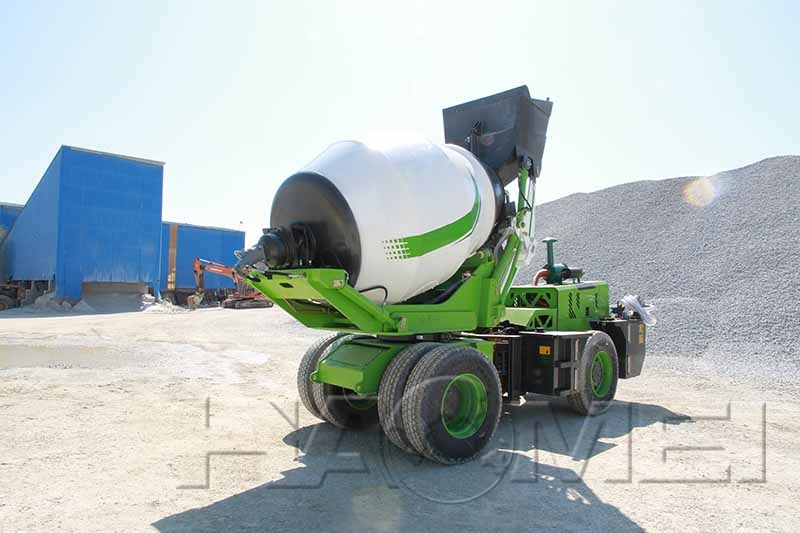
self loading transit mixer

By focusing on measurable productivity, mix consistency, and serviceability, you can shortlist a configuration that fits your typical pour size and site conditions without overpaying for capacity you will rarely use.

Original source: https://www.concretebatchplanthm.com/a/self-loading-concrete-mixer-truck.html

Automatic Cement Brick Making Machine in Zambia

  In Zambia, the construction industry is booming with the acceleration of urbanization and the continuous advancement of infrastructure pro...